The Origins
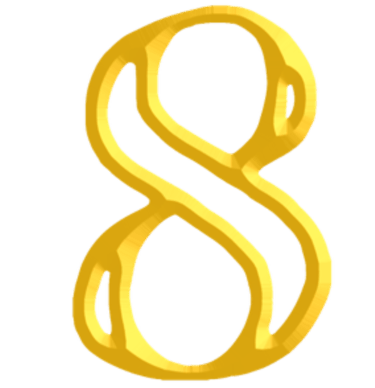
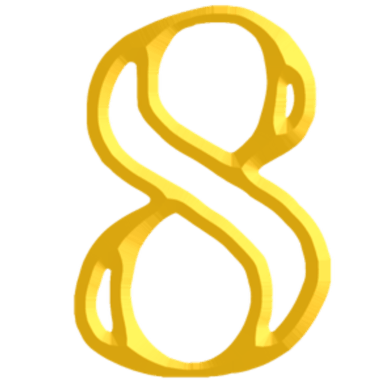
8 is the principle of power, abundance, and regeneration—the force of infinity, balance, and mastery in the material world. Where seven sought understanding, eight brings action, accomplishment, and the harnessing of cycles for progress. Ancient traditions saw eight as the number of cosmic order: the double square, the octagon, the eight-fold path, the star of regeneration. In mathematics and sacred geometry, eight symbolises renewal, success, and eternal flow. In spiritual systems, it is the sign of infinity (∞) turned upright, the union of heaven and earth, and the transformative force at the heart of creation and rebirth.
Global Use of Eight
Africa
Ta-Mery / Kemet (Ancient Egypt): Eight was associated with the Ogdoad—the group of eight primordial deities who represented the balance of chaos and order, darkness and light, water and land. The Ogdoad symbolised the cosmic egg and the birth of the world. Eight also appeared in architectural and ritual designs, marking renewal and protection.
Asia
West Asia – Sumer / Mesopotamia (Babylon): In Sumer and Babylon, eight was the sacred number of Inanna/Ishtar, the planet Venus’s eight-year cycle, and the octagonal ziggurat stages. It denoted abundance, authority, and the completeness of cycles in time, space, and rulership.
South Asia – Bharata / Hindustan (Ancient India): In India, eight is aṣṭa—the eight directions (cardinal and intercardinal), the eight forms of wealth (Ashta Lakshmi), the eight limbs of yoga (Ashtanga), and the eight-fold path in Buddhism. Eight is the energy of prosperity, spiritual progress, and the management of fortune.
East Asia – Zhongguo / Huaxia / Shénzhōu (Ancient China): In China, eight is bā (八), revered as the luckiest number. The Bagua (eight trigrams) forms the structure of the I Ching, feng shui, and Daoist cosmology. Eight symbolises balance, wealth, harmony, and the natural flow of energy in all things.
Americas
Maya (Mesoamerica): The Maya counted eight as the step beyond completion, marking cycles of renewal and balance in their calendar and rituals. Eight was linked to phases of Venus, agricultural cycles, and the regeneration of life and order.
Europe:
In Europe, eight is the number of resurrection, regeneration, and strength: the octagonal baptismal font, the eight Beatitudes, and the octave in music. In mediaeval and modern symbolism, eight stands for the expansion of power, renewal, and the force that turns endings into beginnings.
Modern Global Impact:
Eight governs cycles of time, business (the figure-eight for infinity), economics (cycles of boom and bust), and design (octagonal structures, scales, digital coding). It is the number of achievement, leadership, and the dynamic balancing of material and spiritual progress in a changing world.
Agreeable connotations:
Abundance, power, balance, regeneration, success, mastery, resilience, discipline, ambition, authority, efficiency, resourcefulness, adaptability, leadership, confidence, executive skill, and the ability to harness cycles for continuous growth and renewal.
Disagreeable Connotations:
Ruthlessness, materialism, domination, greed, arrogance, rigidity, workaholism, over-control, insensitivity, obsession with status, intimidation, harshness, the abuse of power, or losing sight of deeper values in pursuit of achievement.