
The Origins
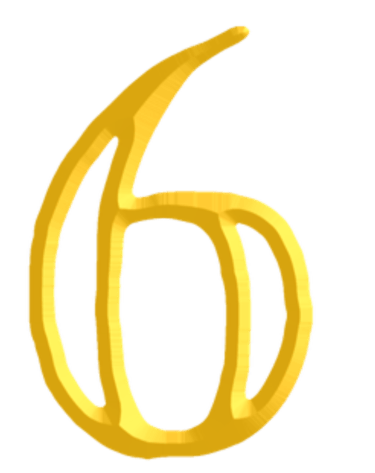
6 is the number of harmony, care, and integration—the force that weaves opposites into wholeness and gives birth to beauty, balance, and nurturing. Where five brought movement and exploration, six arrives to heal, harmonise, and create equilibrium. Ancient traditions saw six as the perfect number: the first that is both the sum and product of its factors (1 × 2 × 3 = 6; 1 + 2 + 3 = 6), a sign of completion in both mathematics and nature. In sacred geometry, six creates the hexagon and the star, the flower of life, and the honeycomb—symbols of interconnectedness, order, and abundance. Six is the home, the community, the compassionate caretaker, and the template for cosmic harmony.
Global Use of Six
Africa
Ta-Mery / Kemet (Ancient Egypt): Six was associated with creation and fertility, often appearing in temple motifs as six-fold patterns, the petals of lotuses, or the structure of time and cycles. It represented completeness and the bringing together of opposites for the flourishing of life and society.
Asia
West Asia – Sumer / Mesopotamia (Babylon): In Sumer and Babylon, six underpinned the sexagesimal (base-60) system—dividing circles into 360 degrees (6 × 60), structuring calendars, and measuring time. Six was the key to cycles, the organisation of society, and the management of cosmic order.
South Asia – Bharata / Hindustan (Ancient India): In India, six is ṣaṭ—the six directions (north, south, east, west, up, down), six seasons in some regional calendars, and the six schools of Hindu philosophy. It marks the harmonious joining of above and below, the balance of earth and sky, and the nurturing force at the heart of family and ritual.
East Asia – Zhongguo / Huaxia / Shénzhōu (Ancient China): In China, six is liù (六), representing fluidity, smoothness, and success. Six directions, six harmonies (liù hé), and the hexagonal structure found in I Ching trigrams and natural forms reflect its power to unite and align.
Americas
Maya (Mesoamerica): The Maya used six dots to represent six and often structured their time cycles and cosmology around sets of six, symbolising balance, harmony, and the completion of cosmic phases.
Europe:
In Europe, six was seen as the first perfect number and appeared in geometry, architecture, and sacred art (hexagons, six-pointed stars, flower of life motifs). It represents care, the ideal household, and the nurturing principles of balance and beauty in life.
Modern Global Impact:
Six governs systems of harmony and integration, from the carbon backbone of organic chemistry (hexagons in molecules) to the six main classes of living things in biology, to music (the hexachord) and design (symmetry and tessellation). It underpins family, community, and the logic of holistic wellbeing in contemporary culture.
Agreeable connotations:
Harmony, care, responsibility, nurturing, empathy, beauty, domesticity, community, service, balance, healing, support, compassion, reliability, protection, love, family, and the ability to bring people and ideas together for the good of all.
Disagreeable Connotations:
Over-responsibility, self-sacrifice, martyrdom, meddling, anxiety about others, possessiveness, interference, perfectionism, codependency, inability to set boundaries, worry, overbearing concern, and the risk of becoming trapped in other people’s problems or neglecting one’s own needs.