The Origins
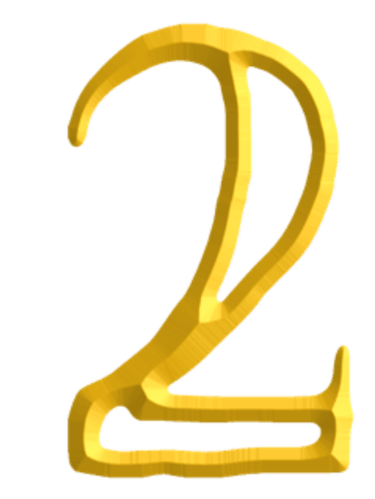
2 is the first act of division and mirroring, the birth of duality, relationship, and contrast. Where one stood as a singular pillar, two is the tension and dance between opposites—light and dark, self and other, question and answer, day and night. Ancient minds saw two as the origin of interaction, the essential rhythm that drives the universe: reflection, comparison, and connection. Two is the mother and child, the joining and the splitting, the double helix and the first true bond. In philosophy and creation myth, it symbolises the necessity of both unity and division for life to unfold. In sacred geometry, two is the line drawn between points—a bridge, a dialogue, the essence of all relationship. In the esoteric and mystical traditions, two expresses the balance of masculine and feminine, the polarity within all cycles, the underlying force of the dance of becoming.
Global Use of Two
Africa
Ta-Mery / Kemet (Ancient Egypt): In Kemet, two is a pair of vertical strokes or figures, symbolising the fundamental duality of Upper and Lower Egypt, the red and white crowns, and the balancing of opposites. The twin feathers of Ma’at, the scales of judgement, and the dual goddesses Nekhbet and Wadjet all reinforce the principle of balance, harmony, and the power of partnership.
Asia
West Asia – Sumer / Mesopotamia (Babylon): Sumerian and Babylonian number systems marked two as a pair of tallies or wedges, the beginning of numbers as relationship. Two was the foundation for early contract, trade, and legal doublets—witness and agreement, question and response.
South Asia – Bharata / Hindustan (Ancient India): In India, two is ‘dvi’—the essential principle of duality, seen in Purusha and Prakriti, Shiva and Shakti, the play of the gunas, and the tension between self and the other. In Upanishadic thought, two is the birth of relationship, reflection, and the eternal dance of complementarity.
East Asia – Zhongguo / Huaxia / Shénzhōu (Ancient China): In Chinese tradition, two is èr (二), represented by two parallel horizontal lines, standing for heaven and earth, yin and yang. The I Ching builds all patterns from the interaction of these opposites, and two is the seed of change and balance in all Daoist cosmology.
Americas
Maya (Mesoamerica): The Maya used two dots as their numeral, symbolising the first extension of sequence and the emergence of pairing and opposition. Two is the pulse that drives their mathematical and calendrical cycles—the beginning of rhythm and duality.
Europe:
In Europe, two emerges as II in Roman numerals, beta in the Greek alphabet, and as the logic of pairs, dyads, and opposites in philosophy, law, and the early sciences. Two grounds the principles of symmetry, partnership, and the resolution of difference.
Modern Global Impact:
Two is the structure of binary code, the dialogue in every communication, the root of every partnership, and the core of all scientific method and relationship. From electricity’s positive and negative, to the social and economic dynamics of pairings, two is indispensable in both the structure and movement of the modern world.
Agreeable connotations:
Partnership, balance, harmony, sensitivity, diplomacy, adaptability, co-operation, receptivity, intuition, patience, duality, care, mediation, support, peace-making, the wisdom of compromise, reflection, nurture, flexibility, sensitivity to others, and the strength found in unity and collaboration.
Disagreeable Connotations:
Indecision, passivity, dependence, anxiety, hypersensitivity, avoidance of conflict, vacillation, being easily influenced, over-compromise, lack of direction, fear of separation, moodiness, resentment, or the risk of losing self in the needs or opinions of others.