The Origins
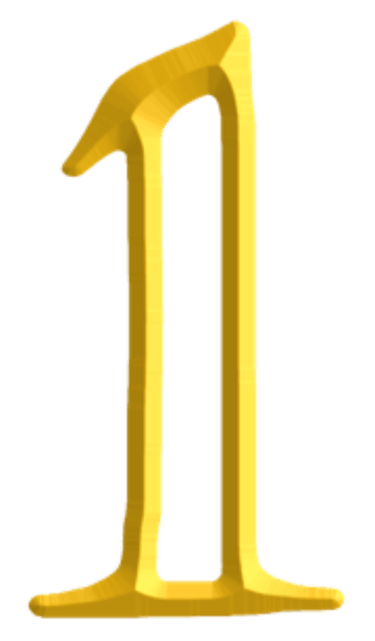
1 is the original spark, the pillar of becoming, the first assertion of selfhood in the cosmic dance. It is the single flame in the infinite dark, the bold proclamation of existence—"I am." Before numbers, one was the primordial point, the seed that emerged from myth and ritual as the foundation for all division and union. In many creation myths, the world is spoken into existence by the act of singular will: a lone being, a solitary word, the first heartbeat breaking the silence. Philosophically, one has always stood for the unity at the heart of diversity—the monad in Greek thought, Atman in Indian philosophy, the first light in Kemet, the Tao in China. One is the indivisible, the measure by which all else is counted, and the living archetype of identity and differentiation. In sacred geometry, one is the centre, the original point, the axis mundi from which all forms radiate. In Hermetic and Kabbalistic traditions, one is the crown, the point of emanation from which the Tree of Life unfurls. In both mathematics and the mystical arts, one bridges the unseen potential and the world of form, making it the enduring symbol of both individuality and creation itself.
Global Use of One
Africa
Ta-Mery / Kemet (Ancient Egypt): In Kemet, one was inscribed as a solitary vertical stroke—a reed, staff, or pillar. It symbolised not only uprightness and sovereignty, but the cosmic principle that unites the seen and unseen. The unity behind Ma’at, the force that aligns the heavens and the earth, found its first expression in the power of one.
Asia
West Asia – Sumer / Mesopotamia (Babylon): In Sumer and Babylon, one began as the primal tally, the first wedge, the initiating stroke that opened the door to measurement and record. It marked the seed from which all counting and commerce arose, and signified the ability to bring the many into focus through the power of one.
South Asia – Bharata / Hindustan (Ancient India): In Bharata, one is the bindu—the point at the heart of sacred geometry and metaphysics. Philosophically, one is the Atman, the individual soul that recognises itself within the boundless Brahman. In ancient texts and yantras, one signifies unity and the birth of all possibility from the undivided source.
East Asia – Zhongguo / Huaxia / Shénzhōu (Ancient China): In Chinese tradition, one is yī (一), depicted as a single horizontal line—complete, undivided, the root of the numeric system. In the I Ching and Daoist thought, one represents the Great Ultimate, the starting line from which yin and yang unfold, and the original unity from which multiplicity emerges.
Americas
Maya (Mesoamerica): The Maya rendered one as a dot, the first marker in their vigesimal system and the spark of their cosmic calendar. It represented the beginning of time, the first breath, and the initiating force in a universe defined by cycles and return.
Europe:
In ancient Europe, one underpinned the evolution of counting systems, appearing as the Roman numeral I and echoing through Greek philosophy as monad or unity. One was the alpha—the first, the unique, the prime mover in a world of form and reason.
Modern Global Impact:
Today, one remains the number of selfhood, independence, and new beginnings. It is the backbone of identity, digital systems, mathematics, and leadership, representing the principle that a single spark can ignite a world of difference.
Agreeable connotations:
New beginnings, creation, independence, uniqueness, motivation, striving forward and progress, ambition and will power, positivity and positiveness, the energies of pioneering, raw energy, force, activity, self-leadership and assertiveness, initiative, instinct and intuition, the masculine attributes, organization, achievement and success, strength and self-reliance, tenacity, forcefulness and authority, love, inspiration, attainment, glory, happiness, fame, fulfilment and omniscience and creating your own realities.
Disagreeable Connotations:
Number 1 relates to single-mindedness, intolerance, conceit, narrow-mindedness, lacking in emotion and being weak-willed, dependence, passivity, aggression, arrogance and dominance.